Case study / Rive Agent
0 to 1 conversational AI for Rive
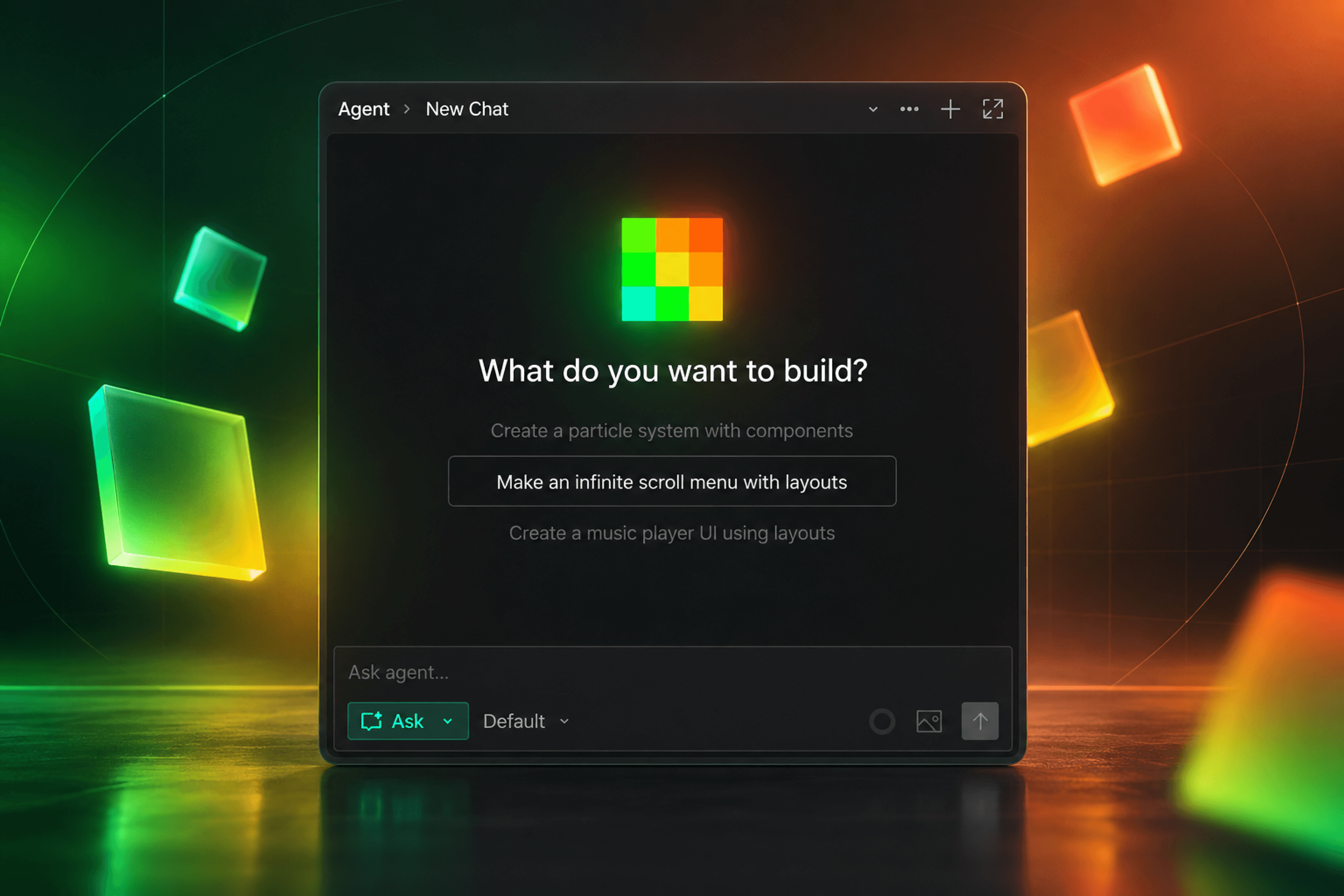
A conversational AI agent for a B2B visual editor, built around the animation on the canvas.
01 / Project description
Why it exists.
At Rive, I owned the in-product AI agent from early exploration and interaction design through production implementation in Flutter/Dart.
Owned from early exploration to production, combining creative tooling, AI-powered product experiences, design systems, and cross-platform development.
Background
Rive’s AI agent needed to feel like a native part of the editor, not a bolted-on chat panel. I owned major improvements to that experience end to end.
The work spanned prompt composition, model selection, Build and Ask modes, image references, thumbnail strips, context controls, history, empty states, and Markdown response export.
I also refined response rendering, scroll behavior, hierarchy, layout, spacing, typography, and formatting so the agent felt more intuitive and dependable while people were making.
02 / Process
How it came together.
Research & Planning
I started with how the agent should live inside an animator’s workflow. That meant understanding where conversation, context, and model choice needed to sit relative to the canvas and the file someone was actually editing.
I collaborated with engineers on overall conversation flow and how models were selected and used throughout the product, so the interaction design and the underlying model behavior stayed aligned.
Design & Prototyping
I redesigned the agent’s core interaction surfaces, including prompt composition, model selection, Build and Ask modes, image references, thumbnail strips, context controls, history, empty states, and Markdown response export.
Beyond the chrome, I worked through response presentation itself: rendering, scroll behavior, hierarchy, layout, spacing, typography, and formatting. The goal was an experience that stayed readable and trustworthy while streamed answers were still coming in.
Development & Implementation
I implemented the work in Flutter/Dart, taking the redesigned surfaces from exploration into production inside the editor.
I designed and implemented context-aware workflows including @-commands, attaching selected code to conversations, and canvas-linked interactions that gave the agent meaningful awareness of the user’s work.
I also built internal debugging tools to inspect streamed responses within the editor and prototype improvements to response presentation.
- Flutter
- Dart
- Rive
- Figma
03 / Results
What it became.
The agent became a more intuitive, dependable part of the editor, with clearer composition, stronger context, and response presentation that held up while people were working.
Context-aware workflows gave the agent awareness of selected code and canvas state, instead of treating the conversation as isolated from the file.